
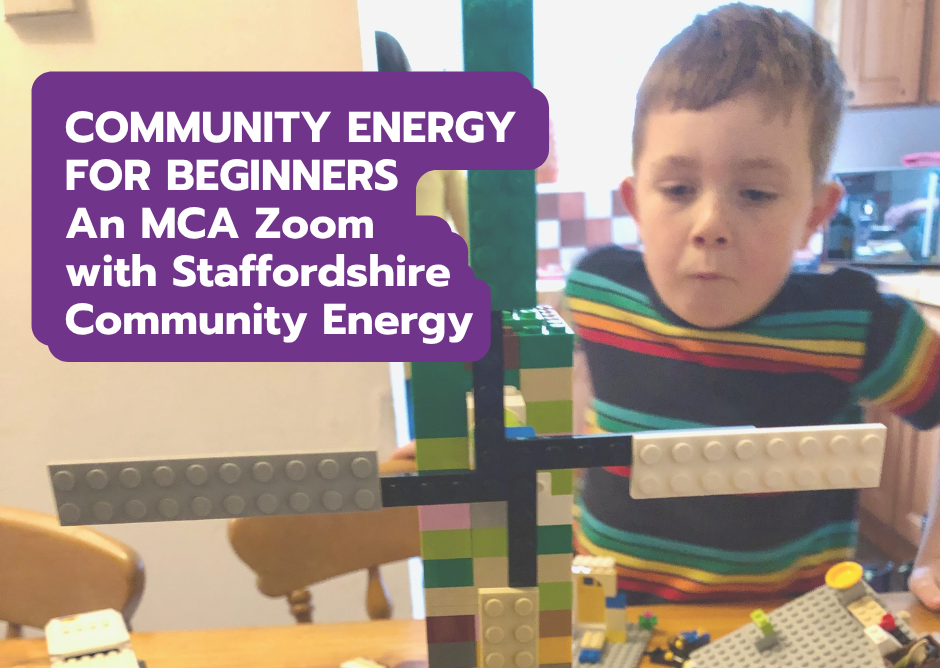
Moorlands Climate Action hosted a Beginners’ Guide to Community Energy in May in what we hope is the start of the journey to having a project in the Moorlands. The session was led by Mike Kinghan, MBE, chair of award-winning Staffordshire Community Energy (SCE).
Mike outlined SCE’s work so far, which ranged from installing solar panels on council-owned housing to a major project with the University Hospitals of North Midlands Trust at the Royal Stoke. Besides providing the hospital with clean energy at slightly below market price, the project also throws off a financial surplus. This money is then invested in a programme run by Beat the Cold.
Over 500 hospital patients have now been given advice and assistance on reducing their energy costs, obtaining new boilers and other improvements, increasing warmth, reducing fuel debts and accessing benefits that are available to them.
Most community energy programmes are considerably smaller scale than this and Mike outlined the variety of options. They could range from a single building with solar PV to a wind turbine that serves a particular village. The Congleton Hydro scheme, for example, is based on a hydro scheme in the Havannah area of that town and the power generated is used by one single user, the local Siemens factory.
 Slightly warmer weather and bluer skies may be making some of us more optimistic, despite all the doom and gloom in the media. It’s good to hear one encouraging bit of news from the Energy and Climate Intelligence Unit - that compared with 10 years ago climate science scepticism has almost entirely disappeared from the opinion pages of British newspapers. The veteran environment correspondent, Geoffrey Lean, also drew attention to positive responses in polls and criticised newspapers for failing to keep up with their readers’ views. That’s not to ignore the extremes of some social media but we progress one step at a time.
In a perfect world, we would be forging ahead in the Moorlands with our own community energy scheme. We’ve reported previously on such schemes and the difficulties in getting them established. Nevertheless, with changing attitudes we think it’s an idea we should keep alive, especially as we’re well placed here for small-scale wind energy and our MP has told us she would not be opposed to a community project. Encouragingly, a very recent YouGov poll shows widespread public support for the creation of community owned, renewable energy projects. Maybe if we keep talking about these, people with the will and motivation to help make it happen will emerge. We can but hope.
In the meantime,...
 Now that temperatures have dropped, we've been able to lend our camera out to members, not just to get feedback from them but also to develop a lending approach that works for both us and them.
So far, it's been going well. We asked potential borrowers to register an interest and then got back to them with a selection of dates for collection and return. At present we're working on Tuesdays and Saturdays for collection, with the camera being returned in time for the next collection date. Collection is usually from the Foxlowe at a mutually agreed time but other locations can be negotiated.
On collection, we introduce users to the camera and show them how to download the associated app. This generally requires a relatively new smart phone, probably no more than five years old - we're learning about the different phones as we go. Usually at least one person in a household has a suitable phone or one that can be borrowed or, if all else fails, we can visit.

As part of our efforts to improve the amount of information on renewable energy available to Moorlanders, Moorlands Climate Action has created an online map of projects in our district. It lists them by type and whether they are operational, approved (or refused). It doesn't yet list new applications and it still has a few gaps but it IS the first of its kind.

Meet Archie, the central character in an inspiring example of community energy next door to the Moorlands. Archie is an Archimedes screw, installed by Congleton Hydro Community Energy to generate electrical energy from the potential energy of water flowing down from the top of Havannah Weir on the River Dane. Now successfully established, the Community project has recently secured the necessary funding for their sister Solar Community project and are forging a promising future with the production of low carbon energy for schools and local businesses.
Even before the establishment of MCA, some of our future members were gazing admiringly across the county boundary at Congleton's intrepid first steps. They were of course blessed with a suitable water potential but we naively thought that if they had water we were well placed for wind. How wrong we were! At that time the government was opposed to onshore wind, as were many local politicians, so we put the idea on the back burner - to coin a hopefully antediluvian phrase.

Decarbonising the heat needed in the tightly packed streets of Biddulph, Cheadle and Leek is a wicked problem, so far without a cost-effective solution. Hydrogen for homes has gone firmly out of fashion, despite new gas boilers being ready to take a blended mix. Air source heat pumps just don’t seem to fit in terraces that face directly onto the street and often have small courtyards out back.
But there are signs that another alternative may be on its way. Late last year, the Department for Energy Security and Net Zero (DESNZ) released a consultation on Heat Network Zoning, where suitable areas of domestic and commercial buildings are grouped together to take low carbon heat from a central source. Community Energy England and partners are looking to push out a model being developed in Rossendale, Lancashire, called Net Zero Terrace Streets. This model covers some of the same territory as heat zoning but is community-centred.
- Trialling Our Thermal Camera
- Thermal Images of a 19th Century Moorlands Hill Cottage
- Winter Warming
- Thermal Camera
- Energy Day Report
- Energy Day 2023
- Moorlands Energy Day is Powering Up!
- Keeping Warm This Winter
- First Ever Energy Fair in the Moorlands
- Helping to Fuel the UK’s Green Industrial Revolution
- Moorlands Climate Action Energy Fair (sponsored by Leek United Building Society)
- Throwing Light on Energy Matters