
- Details
In September 1898, the Skibbereen Eagle ran what was to become one of the world’s most famous ever newspaper headlines. Concerned about the international machinations of the new(ish) Russian Tsar, the small but plucky West Cork paper declared that: “The Eagle will keep its eye on the Emperor of Russia and all such despotic enemies, whether at home or abroad.”
Historians still debate exactly how large a part this thundering Irish editorial played in the fall of the Romanoff dynasty two decades later.
Moorlands Climate Action was founded, of course, to campaign for effective action on climate change, not regime change. And we are resolutely committed to engagement as a means of pursuing our aims, not armed struggle. But against a background of disappointing action at a local level and chaos and confusion at Westminster, we continue to pursue our strategy of relentlessly pressing for action, not words.
Read more: Spotlight Autumn 2022 - Winter Palace or Winter...
- Details
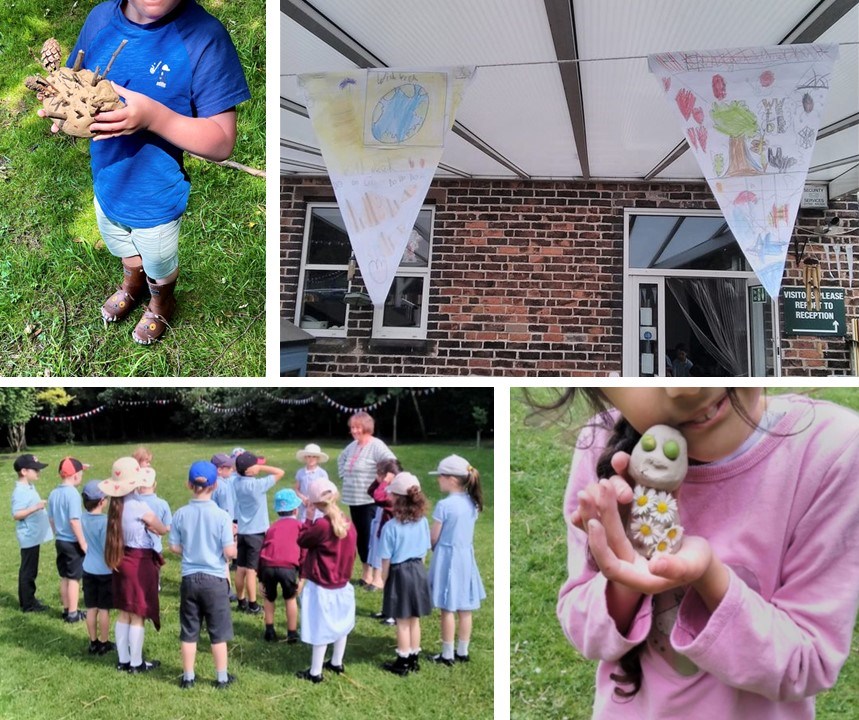 Wild Week, an ‘Eco’ event for children, schools and families, ran between 13th – 18th June, with the aim of exploring nature and having fun out of doors! It was supported by MCA’s Youth Engagement team as part of our activities to protect the environment and to help others learn about climate change.
The programme worked alongside at least 12 local schools, some of which also linked with the Manchester University Great School Science Share, which was all about Climate Change this year. There were lots of fun things to do, such as experimenting, exploring, making things, discovering bugs, plants, wildlife and scavenger hunts.
To make it all happen, we depended on some wonderful adult volunteers who enjoyed working/playing and exploring the natural world with children in the great outdoors. We’d like to give a Big Thank You to all who helped with Moorlands Wild Week, whatever part played in the project, whether a volunteer, teacher, pupil, or behind the scenes with promotion, social media and organisation. Thank You.
- Details
 We were excited to be having a stall at the new Leek Show, not least because we weren’t entirely sure what to expect: who else would be there, would they be friends with us and how would we cope with the logistics?
In the event, it was a tremendous day. The Sunday Supplement Market kindly lent us one of their gazebos and the Foxlowe two of their folding tables, so we were well set up; and in good company too, with the Farming Life Centre on one side, the RSPB on the other, the Crime Prevention Unit opposite us and SMDC and the Young Farmers just around the corner. With enough volunteers on our rota, we were able to explore, revel in all the fun of a traditional agricultural show and talk to lots of other stallholders as well as the many visitors who stopped for a chat at ours. We were particularly pleased to be visited by so many councillors and happy to congratulate Cllr Joe Porter on winning second prize in our Guess the Number of Worms in our Compost Jar competition.
The spirit of the day was well summed up by Mark Johnson in his Facebook post: “What a fantastic day of talking and laughter as half the world dropped by at MCA's stall at the Leek Show. Congratulations to the organisers for working so hard in bringing it back to life and all those who made the day such a success...”
- Details
 At this year’s Hug Green Arts Festival, several visitors came to the ‘Hands up for the Earth’ stall. This had a few visual examples within and outside the tent of small pictures of wildlife, plants, wind turbines, pollution posters etc. All visitors regardless of age, were asked to draw round their hands and either draw or write a message within it of what mattered to them about the Earth and what they would like to say to others, especially people in power.
There were 20 contributions from visitors from the age of 2 through to older adults. Here is a selection of the messages from 9 of the youngest contributors:
- Details
 This year’s green arts festival was another joyful event based on last year’s great success. It included outdoor stalls and children’s activities, crafts, music, drumming, an outdoor hive and willow sculptor, and many indoor stalls and presentations from green organisations and artists.

Bridging the gap on the car park was the fabulous Bogtastic van and the weather was largely fine, despite a short cloudburst in the middle of the day – thank God for gazebos!

It was never going to attract the vast numbers of last year, given the fabulous weather then, our recent emergence from strict Covid rules, and a dearth of competing events and activities. However, we admit we should probably have focussed more on better publicity and communications, which are now at the top of our agenda for next year.
Nevertheless, everyone who came found it an enjoyable, interesting and successful event:
“Music tent was great. My highlight was when the first downpour arrived and the drummers kept us and our fellow 'shelterers' going solidly through the drips.”
“Wish I'd had more time at each stall and in each tent to see more detail. Lots of lovely skills on show.”
Perhaps the most useful feedback was from the young people who participated at the Hands up for the Earth stall, where visitors, regardless of age, were asked to draw round their hands and either draw or write a message within it of what mattered to them about the Earth and what they would like to say to others, especially people in power. Our youngest participant, Lily, aged 2, wanted us to "save Animals" For more details of these, see our website article Hands up for the Earth.
- Details
Three years on from SMDC’s declaration of a climate emergency and we still don’t have a plan that stands a chance of getting to the District’s 2030 Net Zero target.
But we continue to harry, to suggest, and to work in every way we can to achieve that goal.
Last month ten MCA members met in person with a team from Staffordshire Moorlands District Council to discuss how we could better work with each other to pursue our goals. Cllr Joe Porter, the Cabinet Member for Climate Change and Biodiversity, was there, of course, but he was flanked by three other Cabinet Members: James Aberley, Ross Ward and Paul Roberts, the SMDC leader. They were backed by officers from the council: David Smith and Gillian Wright, the new climate change officer. It was at least partly pressure from MCA that was responsible for the appointment of someone like Gillian, in the face of opposition from SMDC.
A wide range of topics was discussed at the meeting, as well as specific ways in which cooperation could be increased. As always, clarity, transparency and accountability in the climate (and biodiversity) process were the foremost of our requests. We did not emerge from the meeting with anything approaching a fully formed new climate plan, of course, and the major action needed in crucial areas such as domestic energy and transport remains a distant prospect.
Still, we expect that there will be a slightly faster pace of progress in a few defined areas such as EV charging points and the use of solar energy in public buildings. What does seem certain now is a better response from SMDC to our enquiries and suggestions. The officers now respond to emails and phone calls and a couple of Cabinet Members now engage in open dialogue with MCA through Facebook. MCA is already re-engaged with officers in initiatives such as the Staffordshire Moorlands Green Network and in general information sharing.
The meeting yielded a little more detail on the forthcoming SMDC Plan for Nature, essentially the council’s preparation for when it plays its role towards the local Nature Recovery Network (NRN). The NRN will be a County responsibility under the new Environment Act, which will only really come into life with the publication of guidelines for biodiversity net gain (for new developments) at the end of 2023. Staffordshire Wildlife Trust has been engaged by the Council to prepare the Plan, but it was clear from the meeting (and an earlier meeting that MCA had with SWT) that there is some disagreement over the likely timetable.
MCA also expressed its worries that preparation of the plan was delaying action in other areas such as a new Tree Strategy for SMDC, now some months overdue.
We also expressed our concerns about delivery under the new plan, given the constraint on resources at both SMDC and SWT – and the patchy evidence for delivery under SMDC’s Green Infrastructure Plan. The Board (made up of SMDC and various other groups including the NFU and SWT) has not met for some time and elected members have not had the chance to scrutinise the Plan’s delivery since the start of 2021.
MCA members have already seen evidence of lack of follow-through – for example, no maintenance of the Brough Park Community Orchard (an MCA member had to remove tree guards which were now strangling the saplings). It is these kinds of on-the-ground concerns that we will have to press SMDC on in the coming months – as well as our wider plans for more information-sharing (and perhaps community maps of projects) if strategies such as Green Infrastructure and the Nature Recovery Networks are to work as they should.
At least, we are now talking.
- HUG 2022 Moorlands Green Arts Festival
- Together We Can: Summit 11th-21st May
- Spotlight Mar- Apr 2022 - Context for an Energy Fair
- Spotlight Jan-Feb 2022 - The Great Energy Transition
- New Year 2022 - New Opportunities and New Challenges
- Moorlands Climate Action AGM
- September-October Spotlight 2021
- Totally Globally - Global Day of Action - 6th November 2021
- CAMINO to COP – A 500 Mile Walk for Climate Justice
- Moorlands Global Day of Action
- July-August Spotlight 2021
- Events up to and Including the Great Big Green Weekend