
- Details
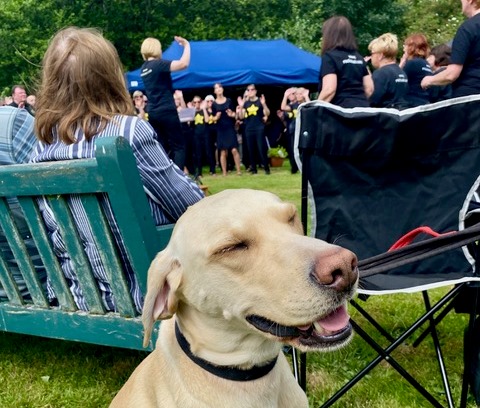
HuG, our Moorlands Green Arts Festival, returns to the Foxlowe on Saturday 27 June from 10.00am to 4.00pm and this year we shall be celebrating water – rivers and stream, springs, ponds and lakes. MCA is a partner in the Nature in Your Neighbourhood project, along with Staffordshire Wildlife Trust, Keele University, OUTSIDE Arts and SMDC. As ever there will be a wide range of stalls showcasing a variety of arts and crafts using different materials, all produced with an environmental ethos.
We’ll be entertained by local storyteller extraordinaire, Gordon MacLellan aka Creeping Toad, as well as Leek Rock Choir and Leek Morris and festival favourites, the Leek U3A African drummers. New stallholders include Wheatcroft Willow – basket maker Rachel Evans – and the Staffordshire Makers Collective. Joining us again will be Moral Fibres – preloved textiles and notions – and Projects from Pallets.
On the Staffordshire Wildlife Trust stall you’ll be able to look into their aquarium and take a peek at pond life while Leek Books will have books of a watery nature for all ages to add to your collection. Perhaps our plant stall will have marginal plants for your own pond. Local nature and environmental groups such as Swifts of Leek and Friends of the Earth will also be there.
We’re hoping for good weather yet again, though perhaps not as hot as last year! And to ensure a great day out for everyone, we’re looking for volunteers to help on the day with a variety of tasks, from helping stallholders set up to selling raffle tickets.
If you can give us a hand, please get in touch by completing the form below.
- Details

The first round of consultation for the Peak Cluster Carbon Capture and Storage project has begun. Follow the link for more details. The project aims to capture the CO2 produced as a by-product from cement and lime-making at four sites in Derbyshire and Staffordshire and then pipe it for long-term storage in depleted gas fields in the Irish Sea.
The project has already divided opinion. Some see it as the only way to decarbonise an essential industry in the timetable required to meet UK climate targets. Others argue for a more fundamental reshaping of the way we approach growth, or that there are cleaner alternatives to cement.
One potentially hard-to-understand issue is whether there is enough storage for the CO2 and, if so, whether it is safe.
In an attempt to help inform the discussion on that specific subject we’ve brought together some links to what evidence is already out there. The list does not claim to be comprehensive, nor has it been selected to advance one side or other of the debate.
Capacity
This recent research paper published in Nature seems pretty definitive and argues that safe storage is very significantly less than previously estimated but that CCS almost certainly will have a pivotal role in reaching climate targets.
Here is a summary by the report’s authors for Carbon Brief.....
- Details

Over 250 people joined us to take part in our first Wassailing celebration in January. After months of planning, it all came together with residents witnessing the awakening of the trees at the orchards in the West End of Leek, supported by Leek Morris, drummers and our special visitor – the fabulous Curlew courtesy of Outside Arts.
The purpose of the event was to raise awareness of the Community Orchards in Leek and bring back an old tradition that goes back almost a thousand years.
Children ‘toasted’ the trees with bread soaked in apple juice, while shouts of Wassail rang around the orchard. The giant Curlew was a favourite with young and old, adding a definite Moorlands twist to the traditional wassailing – we even managed to include a reference to oatcakes in the songs.
We are keen to get your comments on the event, so if you attended, please do give us your feedback here - Wassail Feedback. We hope to repeat the event next year, elsewhere in the town – if you would be interested in making it happen, look out for details of the planning meeting in the summer.
Leek town council have a video of the event here - https://www.facebook.com/100064678571095/videos/moorlands-wassail/1848098562499806/
See our illustrated report - Download Wassail_2026
- Details
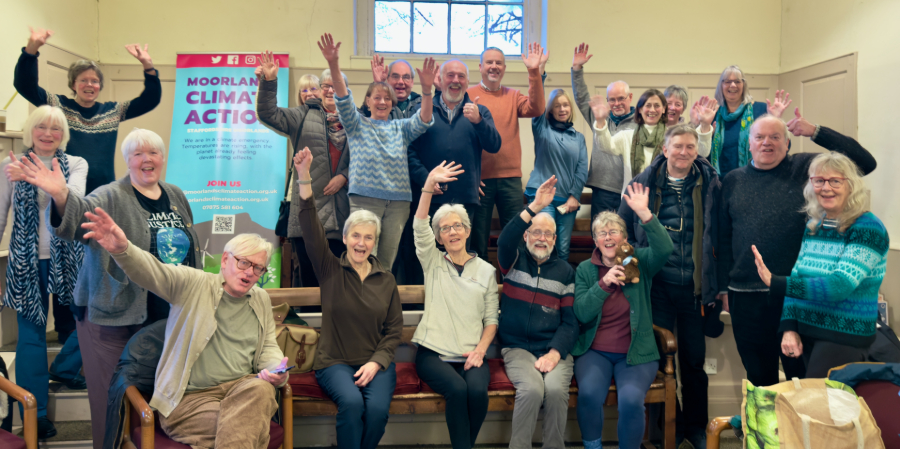
It was great to see 32 members join us on 23rd November at the Friends Meeting House - a record attendance and always good to see some new faces.
After the formalities of the re-election of the committee and noting the handover of Membership Secretary from James to Simon, our group coordinators gave a talk about the varied work they had managed throughout the year. Their reports were circulated prior to the meeting or given as a verbal update on the day.
A few items that were noted:
- Staffordshire Moorlands District Council is planning a public consultation on its updated Climate & Nature Action Plan, and MCA are looking to work with SMDC to co-design how this will be delivered.
- We hope to be able to take a Student Placement in 2026 from Keele University, primarily to work on our marketing approach, both internally to existing members, and externally, to attract more members.
- The Nature group are always looking for more volunteers to get involved with projects.
- The Energy Group would welcome more people to get involved with the thermal camera project - helping develop a lending policy as well as helping interpret the results to people who borrow the camera. Longer term, we would like to develop a directory of local energy efficiency contractors that have been recommended by our members.
- Transport - this is not a very active group, but there is huge potential to work up proposals around the emerging County Transport Plan. If you have an interest, please do get in touch.
There was then an open forum for any member to raise items.
- Youth - how can we work closer with schools and other institutions, including sixth forms and support the promotion of careers in the Green industries?
- How to respond to the rise of climate change deniers - in Staffordshire, nationally and internationally?
The Group photo shows some of our members at the end of the meeting.
- Details
This has been another tremendous year of progress for Moorlands Climate Action - our membership has continued to increase, we’ve taken on even more projects and we’ve achieved some noticeable firsts.
Our first Youth Conference, timed to coincide with COP 30 in Brazil, was launched on 11 November, bringing together students from across the Moorlands to learn more about green careers, decarbonisation, adaptation and biodiversity. Our Youth Action team worked really hard to pull this conference together and, with over a dozen organisations taking part, it is a great example of what a small group of people can do when they are determined – see our next newsletter for a full report.
Another first was the invitation for Moorlands Repair Café to represent Staffordshire at a conference in the House of Lords, to promote the campaign for more support for the Recycle, Repair, Reuse message. One of our repairers, John, had a great afternoon talking to MPs and government officials, as well as other Repair Café teams from around the UK.
In partnership with local town councils, libraries, Waste Savvy Staffordshire, OUTSIDE, Move More and local police, the Chain Reaction project has continued to encourage more people to take up cycling. Our Repair Café team has welcomed a number of new volunteers who have allowed us to provide support for the first bike repair workshops in Cheadle and Biddulph.
The Plastic Free Leek project has continued to sign up new members, including schools, and we were delighted to hear we had our first Silver Award winner – the Lion House Tea Rooms.
This all sounds brilliant, and it is, BUT…we now have a County Council that voted to rescind its own Climate Emergency declaration and cancel targets for Net Zero. The government’s Planning and Infrastructure Bill is posing a serious threat to nature. Trump is promoting fossil fuel expansion and, here in the UK, Reform are calling for an end to the ban on fracking.
All these hurdles make our work more important than ever. Moorlands Climate Action needs to be part of the growing coalition of groups across the planet who call for change – while there is still time. We’ve shown what’s possible when a community comes together, but we can’t let up now. There’s more work to do, more voices to join, and more ways to protect our world for everyone.
So, 2025 was packed with progress, new projects, and more people getting involved. Even with the setbacks all around us, our passion hasn’t faded. Let’s keep moving forward, keep inspiring, and keep fighting for climate action—while we still can! And why not join us at our upcoming AGM?
- Details

It’s sometimes a struggle to keep going with our various projects, especially with the rising levels of climate scepticism we see in the news and social media. That’s on top of the deluge of scientific papers reporting ever increasing levels of emissions, deforestation, water and air pollution that we also see every day. Let’s not mention the latest threats to ‘Drill, baby, drill’ from members of one UK political party.
That came home to me recently when I started reading an article referenced in the Guardian – Connecting with Nature. In between the stories about wildfires and flooding in Europe, this article was a little beacon of hope. Written by Miles Richardson, Professor of Human Factors and Nature Connectedness at the University of Derby, the report gives a good summary of the problem, possible solutions and a forecast of what will happen if we do not act NOW.
The article documents the massive decline in everyday human interaction with nature – 60% since 1800, which mirrors a reduction in the use of nature related words in our literature - words like river, blossom, moss, and bough. In Sheffield, it is estimated that residents only spend an average of 4.5 minutes per day in a natural space.
A connection with Nature is so important to us – it improves our physical and mental health; it makes us aware of the changes to climate and the impact on nature; and it helps us retain our skills in food production, forestry and preservation of waterways. The forecast is that it will only get worse….unless we do something about it.
So, what is recommended ?
1. Parental influence is key to encouraging greater levels of nature connectivity in later life
2. Drastically increasing biodiversity in our green spaces
3. Instilling awareness of and engagement with nature in young children and families, such as in forest schools.
All this will take concerted effort from government, local authorities and the public.
So where does Moorlands Climate Action fit into this?
- Brilliant Day for All at HuG 2025
- Attenborough’s Ocean Film Comes to Leek
- Changing Times – a personal note from our Co-ordinator
- Spotlight Spring 2025 - Stemming the Tide?
- Fifth HuG Festival Bigger Than Ever
- Spotlight Winter 2025 – What can WE do about river pollution?
- Spotlight Autumn 2024 - Water, water everywhere, nor any drop to drink
- Farewell X/Twitter
- Life in The Ravines
- Leek Textile Week
- Climate Expo and Sustainability Conference
- Action West End Family Fun Day